「博雅教育5×5倡議」簡介

面臨「雙A(AI人工智能 + Aging高齡化)時代」的挑戰,以「雙B(BI基本收入+BL基本[健康]生活型態)」的因應會更有長遠效果。
例如:推行「學:終身學習五戒」與「健:身心健康五戒」之維持基本「智能、體能」如下所述之各種生活型態(Basic Life styles),可以減少個人與社會經濟負擔,並結合社區發展,提升各種社群的服務智能與體能,以及從禪修、腦科學練習「身心調和五事:身、息、念、受、想」之定慧,形塑「公民博雅文化」,增進大眾的生活品質與公民素養,這些「2種5戒、調5事之定慧」是我們提出「博雅教育5×5倡議」的緣起雛形。如下圖所示:

因應「後疫情時代」,避免多人密集,活動空間設計以重質不重量之「彈性、多功能」「現場自省體驗」為主,
發揮設計與設備即教材的效果;並善用網際網路以及VR(虛擬實境)、AR(擴增實境)、MR(混合實境)等XR(延伸實境,Extended Reality)裝置,突破時空限制與提供沉浸式、互動性體驗,建置「虛實互補」數位學習資源,以便大眾參與,教學相長,互為主伴,形成「心淨、行淨、眾生淨、國土淨」的因果鏈,成就大眾,莊嚴淨土,也就是<博雅教育5×5倡議>的願景。
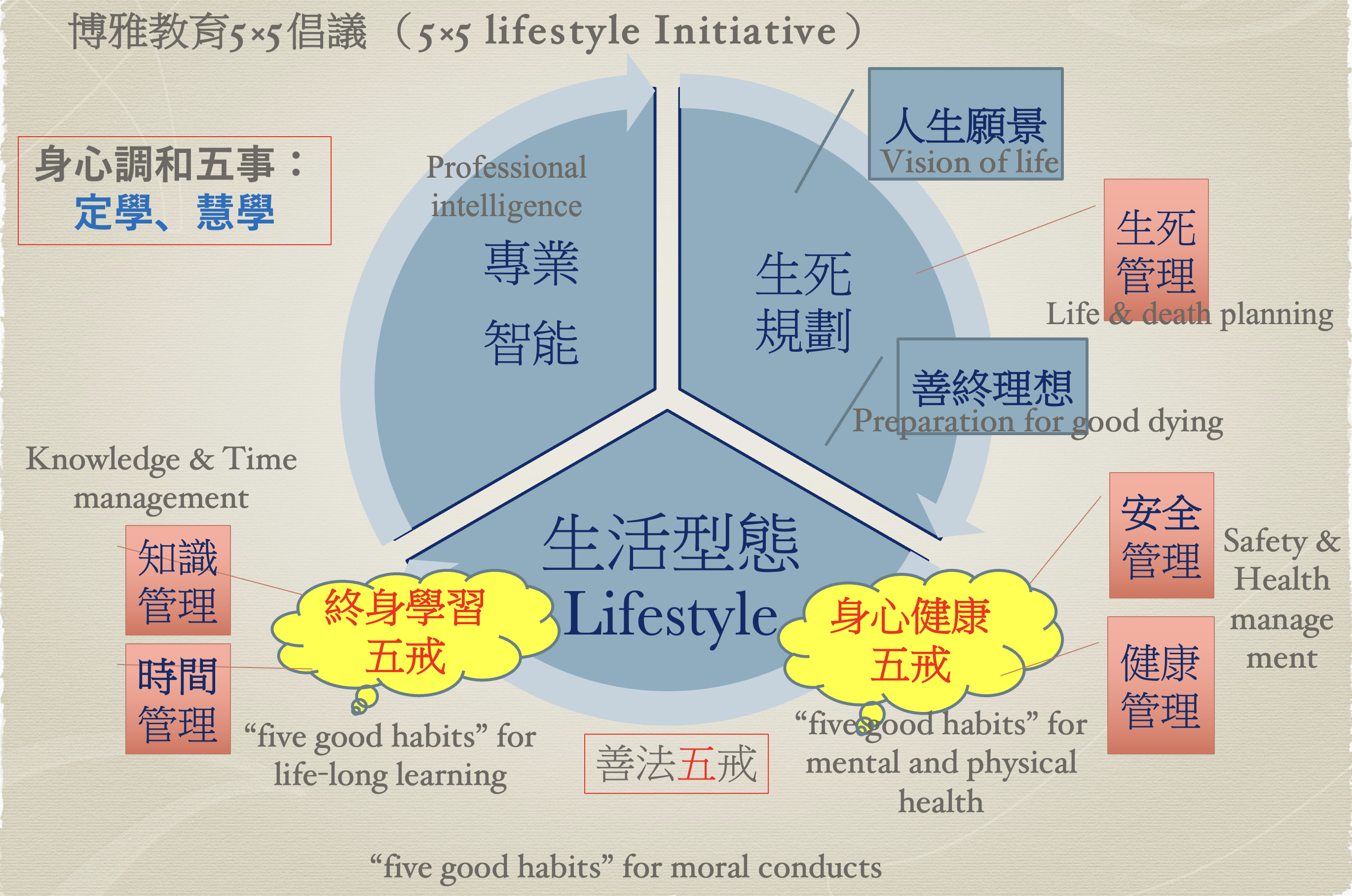
(一)優質善法五戒:

  1. 不傷害︰救護生命,珍惜環境。
  2. 不偷盜︰樂施資財,奉獻社會。
  3. 不邪婬︰敬愛家人,尊重信任。
  4. 不妄語︰誠信正直,善意溝通。
  5. 不飲酒︰正念正知,清淨身心。

詳參拙文⟨優質佛教徒終身學習守則–五戒新詮⟩(《人生》雜誌267期,2005年11月)。

(二)終身學習(博學)五戒:閱讀、記錄、研究、發表、實行:詳參考拙文<終身學習五戒>(《人生》雜誌359期,2013年7月); <資料記憶與知識管理>(《人生》雜誌298期,2008年6月);<「阿賴耶識」記事本:聞思熏習、轉識成智的方便法門>(《人生》雜誌333期,2011年5月);<「重重無盡」記事本:Roam Research(雲遊研究)>(《人生》雜誌455期,2021年7月)

(三)身心健康(雅健)五戒:微笑、刷牙、運動、吃對、睡好:詳參考拙文<身心健康「五戒」>(《人生》雜誌326期,2010年10月);<身心健康「五戒」四句偈>(《人生》雜誌298期,2011年9月)

(四)禪定智慧:調和五事:詳參考拙文<從禪修、腦科學談身心調和五事(I)>(《人生》雜誌419期,2018年7月);<從禪修、腦科學談身心調和五事(II)>(《人生》雜誌420期,2018年8月)

  1. 調身(姿勢):動靜節律、鬆緊自在…
  2. 調息(呼吸、語言):覺知出入、長短…
  3. 調念(作意):自他、生滅平等
  4. 調受(感受):苦樂同功、向上轉內
  5. 調想(認知):順逆、善惡同源

(五)淨土學五管:知、時、生、安、康

  1. 知識管理:詳參拙文⟨「阿賴耶識」記事本:聞思熏習、轉識成智的方便法門⟩(《人生》雜誌,2011年5月);<重重無盡的記事本-Roam Research(漫遊研究)(《人生》雜誌,2021年7月)。
  2. 時間管理法:詳參拙文⟨拖延與番茄工作法⟩(《人生》雜誌2016年11月);<《校長的番茄時鐘》自序:番茄時鐘‧惜時如金>
  3. 生死管理:詳參拙文⟨生死三關⟩(《人生》雜誌2009年10月);⟨生命細胞之生死觀:善終的多樣性⟩(《人生》雜誌2011年3月);⟨退休•善終?!⟩(《人生》雜誌2014年4月);⟨安寧療護與「生死四道」⟩(《人生》雜誌2016年3月);⟨生死管理:夏花與秋葉(《人生》雜誌2021年4月)等。
  4. 安全管理:充實個人、家庭、機構、社區乃至社會的安全管理智能。
  5. 健康管理:經由定期體檢早期發現疾病,並作連續監測和有效控制。

猶如拙文⟨雙A時代的挑戰與雙B的因應⟩(《人生》雜誌432期,2019年8月)提到:對於雙A(AI人工智能 + Aging高齡化)時代的挑戰,「雙B(BI基本收入+BL基本[健康]生活型態)」的因應會更有長遠效果。例如:推行「身心健康五戒」與「終身學習五戒」之維持基本「體能、智能」生活型態(Basic Life styles),進而擴展為「博雅教育5×5倡議」,如此可以減少個人與社會經濟負擔,提升全民的服務體能與智能,增進大家的生活品質與公民素養,這或許是建設「人間淨土」的基本方針。

t2025.11.10 身心調和之寓言故事__NTPU

百歲人生之「失智症」或「認知症」名稱議題

  • 釋惠敏 法鼓文理學院前校長,國立台北藝術大學、法鼓文理學院名譽教授
  • (本文發表於《台灣臨床佛學研究協會會訊》47期,2025年1月)
  • 2019年1月6日,在台灣正式實施亞洲第一部《病人自主權利法》,
    • 更進一步讓我們對於病情、醫療等各選項之可能成效與風險預後,有知情之權利以及對於醫師提供之醫療選項有選擇與決定之權利。
    • 簽署人未來若符合
      • (1)末期病人(原「安寧緩和醫療條例」適用)、更擴大範圍至
      • (2)不可逆轉的昏迷狀態、(3)永久植物人、(4)極重度失智、
      • 或(5)其他中央主管機關公告的重症等狀況時,
    • 就能依照自訂的醫療決定,接受或拒絕維持生命治療或人工營養及流體餵養之全部或一部,走完人生最後一程。
  • 其中,有關(4)極重度失智的狀況,是我們擔任臨床宗教師乃至全民都應該需要關注的議題。
    • 因為,20世紀後半以來,人類的平均壽命逐漸提升, 2016年,英國倫敦商學院琳達·格拉頓(Lynda Gratton)與 安德魯·斯科特(Andrew Scott)教授出版 The 100-Year Life: Living and Working in an Age of Longevity(《百歲人生:長壽時代的生活和工作》), 為個人、企業與政府描繪未來世界的挑戰與機會:
  • 2007年後出生的孩子有一半會活到100歲。未來如此的「超高齡」社會,
  • 但是人腦在成年後幾乎不會有新生神經元的補充,隨著衰老,人腦的功能呈現不可逆轉的退化, 如此將有多少比例會有神經退行性疾病的可能性?我們需要未雨綢繆。

目前,全世界阿茲海默症(神經退行性疾病之中,發病率最高的一種)約有4000萬人,人群發病率在0.5-0.7%左右,但高齡之後,65歲以上,發病率7%;80歲以上,發病率17%;90歲以上,發病率接近50%。

  • 在台灣,65歲以上發病率約7.8%, 以新北市106年65歲以上高齡者有65萬人,若按照上述比例計算,將有5萬多患者。
  • 2017年開始,台灣衛生福利部推動之長照 2.0 計畫之服務對象是對失智症評量表(CDR)值2-8級;
    • 近年,考量預防延緩失能失智推動策略,對於以照顧管理評估量表評量結果 「未符合」長照需要等級 2 級以上之衰弱老人,及疑似或輕度失智症者,能提供初級預防及服務場域,
    • 推動「失智照護服務計畫」,設置 「失智共同照護中心」(簡稱「失智共照中心」)及「失智社區服務據點」( 簡稱「失智據點」),
    • 以提供無法進入長照給支付體系之「失智、未失能」個案相關服務。
    • 為提供失智症者及其照顧者服務可近性及延續性,辦理「失智照護服務計畫」,以提高失智照護服務涵蓋率。
  • 從上述的因緣,以及因應阿爾茨海默症之「認知儲備」(cognitive reserve)理論,養成終身學習、控制過激情緒、參加社交活動、健康飲食、規律運動等生活習慣,有助於延緩大腦神經元衰老和死亡。
  • 所以,佛教臨床宗教師或許可以善用社區與佛友的力量,協助失智症評量表(CDR)值2以下(0.5以上)值的社區或佛友長輩
    • ,及早參加非藥物治療之認知課程、預防及延緩失能照護課程等活動,減緩失智症個案的退化 ;辦理照顧者支持團體/照顧者訓練課程,與個案及家屬建立良好的關係,進行關懷訪視,提供情緒支持、資源網絡;辦理各種心靈性支持活動,例如念佛共修等活動,同時讓其他高齡佛友參與課程;鼓勵身心狀態良好的佛友擔任鐘點照服員。佛友們除了一起學習之外,可以互相照應與支持,推廣佛教對於失智症預防以及因應的理念,利人利己。
  • 最後,我們期待台灣的相關主管機關對於「失智症」(Dementia)的名稱,也能提出改名的議題,因為對於"Dementia"之翻譯,
    • 台灣是用「失智症」;
    • 中國大陸用「癡呆」;
    • 香港用「認知障礙症」,
    • 澳門用「腦退化症」,
    • 日本用「認知症」。
  • 面對未來超高齡社會快速來臨,高發病率的Dementia患者,如何「去污名化」可能是我們因應的關鍵, 例如日本所採用的「認知症」名稱,比較容易讓患者、家屬、親友、社區、社會,以「平常心」適當的談論此議題, 容易讓患者獲得尊重與支持,如此也可以提高失智照護服務涵蓋率, 因為我們所面對的不僅是醫療資源的分配,更是人性尊嚴與生命意義的挑戰, 讓我們一起推動去污名化的議題,創造一個更加友善與包容氛圍的社會環境,利人利己。

The Four Kinds of Clear Comprehension 四種正知pp. 42-51

Nyanaponika(1962)The Heart of Buddhist Meditation: The Buddha’s Way of Mindfulness

  • Buddhist tradition as embodied in the commentaries to the Buddha’s Discourses, distinguishes four kinds of Clear Comprehension:
    • (1) the Clear Comprehension of Purpose(sātthaka-sampajañña),
    • (2) the Clear Comprehension of Suitability (sappāya-sampajañña),
    • (3) the Clear Comprehension of the Domain (of Meditation; gocara-sampajañña),
    • (4) the Clear Comprehension of Reality (lit. of Non-delusion; asammoha-sampajañña).
  • 佛教傳統(如體現在佛典的註釋書中) 將「清楚理解」(sampajañña)區分為四種類型:
    • (1) 目的之清楚理解(sātthaka-sampajañña):明確理解行為的目的與意義。
    • (2) 適合性之清楚理解(sappāya-sampajañña):明確理解行為是否適合自身的修行與環境。
    • (3) 所緣境之清楚理解(gocara-sampajañña):明確理解內觀修習的範圍與對象。
    • (4) 實相之清楚理解(字面意義為「不迷惑」asammoha-sampajañña):明確理解現實的本質,不受錯覺所惑。
  • 1. Clear Comprehension of Purpose【growth in the Dhamma (dhammato vuddhi)】
    • This first kind of Clear Comprehension enjoins that, before acting, one should always question oneself whether the intended activity is really in accordance with one’s purpose, aims or ideals, i.e. whether it is truly purposeful in the narrower practical sense as well as in view of the ideal.
      • 這第一種類型的「清楚理解」要求,在行動之前, 人應該時常自問, 這一行為是否真正符合 自己的目標、理想或願景 ——換言之,無論從狹義的實用層面 還是從理想的高度來看, 這一行動是否真正具有意義。
    • The timely pausing for putting that question —if this is not already customary with the practiser— will have to be learned through the training in Bare Attention.
      • 如果修行者尚未養成這種習慣, 那麼他需要透過「純然覺察」(Bare Attention)的訓練 來學習這種適時的停頓與自省。
    • Some may think that there is no need to make purposeful action a special subject of their study or training, because they believe that, as ‘rational beings5, they naturally act ‘rationally5, i.e. purposefully. But quite apart from the ultimate purpose of the Way of Mindfulness, it will certainly be admitted that man does not always behave rationally at all; not even when the purpose he has in mind is quite narrow and thoroughly selfish and materialistic. Man often forgets about his purposes, programmes and principles, neglecting even his most obvious advantage and all this not only through rashness or passion, but even on account of quite casual whims, childish curiosity or lazy indolence. For these, or other secondary reasons, people are often deflected into directions that are quite other than their proper aims in life and their true interests.
      • 有些人可能認為,無須特別學習或訓練「有目的的行動」,因為他們相信自己作為「理性存在」,自然會以「理性」的方式行動,即具有目的性。然而,且不論「正念之道」的終極目標,事實上,人類並非總是理性行事;即便當人心所懷之目的狹隘而完全以自私與物質為導向,人也未必能真正理性地堅持其目標。人常常會忘記自己的目的、計畫與原則,甚至忽略最顯而易見的利益,而這不僅僅是因為衝動或激情所致,甚至可能只是隨機的心血來潮、幼稚的好奇心,或純粹的懶散與怠惰所導致。由於這些或其他次要的因素,人常常被引向與自己真正目標與利益完全不同的方向。
    • Under the impact of the innumerable impressions crowding upon man from the world of outer and inner multiplicity (papañca), an occasional deviation from the general direction of oneJs life is certainly understandable and, to a certain extent, even unavoidable, for the most of us.
      • 在人所面對的外在與內在世界的無數印象(papañca,即心理的增盛與複雜化)衝擊之下,偶爾偏離人生的整體方向是可以理解的,對大多數人而言甚至是無可避免的。
    • All the more does it become necessary to limit such deviations to the very minimum, and to strive for their complete elimination which however is realized only in the perfect Mindfulness of the Saint (arahat).
      • 因此,更有必要將這種偏離降至最低,並努力完全消除它——儘管這種徹底的消除只有在「阿羅漢」(arahat)圓滿的正念之中才能實現。
    • But these deviations from the straight path of purposeful living cannot be excluded, or even considerably reduced, by an enforced subordination to the dictatorial commands of dry reasoning or moralizing.
      • 然而,這種對於目標明確之生活方式的偏離,並不能單靠枯燥的理性命令或道德說教來排除,甚至難以有效減少。
    • The emotional side in man for which such whimsical deviations or escapades are often an outlet or a kind of protest, would soon revolt and even retaliate by some demonstrative irrationality of behaviour.
      • 因為人心中的情感層面,對於這些偶然的脫軌或逃避行為,往往視之為一種出口或抗議方式,若強行壓制,則可能引發更強烈的反抗,甚至報復性地表現出某種刻意的非理性行為。
    • In order to achieve a ‘peaceful penetration, of the irrational regions of mind, and to win them over for willing participation in the realization of clearly comprehended purpose, work has again to ‘start at the beginning,: on the broad foundation of Bare Attention. By the simple, non-coercive and harmonizing methods of that practice, the tension-creating forces within the mind which obstruct purposeful activity, will gradually be absorbed into the main current of one’s aims and ideals.
      • 為了能夠「和平地滲透」心識的非理性領域,並讓這些部分願意自發地參與到清晰理解的目的實現之中,仍然需要「從基礎開始」,即以「純然覺察」為根本方法。透過這種簡單、無壓迫且能促進和諧的修習方式,那些阻礙目標導向行動的內在緊張因素,將逐漸被吸納並融入到自身的目標與理想的主流之中。
    • A purposeful co-ordination of the various tendencies and needs of the human mind, and of the numerous human activities, will be achieved only through a systematic, but organic and natural extension of conscious control, or self-mastery.
      • 唯有透過有系統但又有機、自然地擴展「意識控制」或「自我掌控」,才能夠實現人類各種心理傾向與需求的有目的協調,以及對眾多活動的有效整合。
    • Only in such a way can an increasing balance of the emotions and a general harmony and stability of character result—to which finally all waywardness, all arbitrariness, down to the ‘demonstrative irrationality’ of behaviour and self-destructive tendencies, will become fundamentally alien.
      • 只有這樣,情感的平衡才能逐步增強,個性的整體和諧與穩定才能夠形成——最終,所有的任性行為、隨意性、甚至刻意表現出的非理性行為與自毀傾向,都將變得根本無法相容。
    • The safe basis of such a self-mastery, i.e. of sense-control and mind-control, is the non-coercive method of Bare Attention.
      • 這種「自我掌控」(即感官與心識的控制)的安全基礎,就是「純然覺察」這種無壓迫的修行方式。
    • By strengthening the habit ‘to stop and think’, it gives to Clear Comprehension of Purpose an increased chance of coming into operation; and by its presentation of undistorted facts it provides for Clear Comprehension the reliable material for making its decisions.
      • 透過強化「停下來思考」的習慣,「純然覺察」能夠讓「清楚理解目的」更容易發揮作用;同時,透過提供不被扭曲的事實,它也為「清楚理解」提供了可靠的決策依據。
    • It may happen, and cause deep regrets afterwards, that a high ideal, or an important purpose that was forgotten or temporarily pushed aside for the sake of a passing whim or fancy, becomes, before being taken up again, completely unattainable owing to a changed external situation caused by oneself, through just these incidental excursions. The ideal, or purpose, may likewise become unattainable owing to an inner change in the individual himself, caused by the same behaviour. There will be less regrets for lost opportunities if one cultivates Clear Comprehension of Purpose until it becomes deeply engrained in oneJs nature.
      • 有時,人可能會因為一時的心血來潮或隨機的興趣,而暫時擱置甚至完全忘記某個崇高的理想或重要目標,然而當他試圖重新回到這一理想時,可能會發現由於外在環境的變化——這種變化恰恰是由自己過去的這些偶然行為所導致的——該目標已經變得完全無法達成。同樣,由於個人內在的變化(也是由於相同的行為模式所促成的),該目標也可能變得無法企及。若能培養「清楚理解目的」,使之深植於自身的性格中,那麼對於錯失良機的懊悔將會減少許多。
    • If, on the other hand, one habitually yields to all whims, or allows oneself too easily to be deflected from oneJs purpose, then such qualities as energy, endurance, concentration, loyalty, etc., will gradually be undermined and weakened to such an extent that they become insufficient for achieving that original purpose, or even for truly appreciating it any longer. In that way, it often happens that, unheeded by the person concerned, his ideals, religious convictions, and even his ordinary purposes and ambitions, are turned into empty shells which he still carries along with him, solely through habit.
      • 另一方面,如果一個人習慣於屈從於所有的突發興趣,或過於輕易地偏離自己的目標,那麼像「精進」、「堅忍」、「專注」、「忠誠」等品質將會逐漸被削弱,以至於它們最終不足以支撐其最初的目標,甚至使得他無法再真正珍視這些目標。這種情況往往導致,當事人自己並未察覺,他的理想、宗教信念,乃至最基本的目標與志向,都已經變成了空洞的外殼,只是由於習慣而仍然維持著其表面存在。
    • These remarks may suffice to show the urgent necessity for a strengthening of purpose in action, and for extending its orbit. This is done by the constant presence of Clear Comprehension of Purpose.
      • 這些討論足以顯示:加強行動中的目的性並擴展其影響範圍,是極為迫切的需求。「清楚理解目的」的持續運作,具有消極與積極的雙重作用。
      • It has the negative function of counteracting the desultoriness, aimlessness and wastefulness of an inordinately great part of human activity, in deeds, words and thoughts.
        • 消極方面,它能對抗人類行為中極大部分的漫無目標、缺乏方向與浪費現象,無論是行為、言語還是思維。
      • Its positive function is to concentrate the dispersed energy of man, to render it a fit tool for the task of winning mastery over life.
        • 積極方面,它能夠將人類分散的能量集中起來,使其成為掌控生命的合適工具。
    • In this way, Clear Comprehension of Purpose makes for the formation of a strong inner centre in oneJs character, powerful enough to coordinate gradually all oneJs activities. Again, Clear Comprehension of Purpose strengthens mind’s leadership by giving to it skilful and determined initiative in cases where mind used to yield passively or react automatically to pressure from within and without. It also takes care of wise selection and limitation in man’s activity, which is necessitated by the confusing multitude of impressions, interests, demands, etc” with which we are faced in life. Strong purposefulness will not easily be diverted by them.
      • 透過這樣的方式,「清楚理解目的」能夠促成內在強大核心的形成,使其有足夠的力量來逐步協調人的一切行為。此外,「清楚理解目的」透過提供明智而果斷的主導權,使得心識在那些過去習慣於被動屈服或機械性反應的情境中,能夠採取積極的行動。它同時負責對人類活動的明智選擇與限制,這是面對生活中無數雜亂印象、興趣、需求等時所必須的。強烈的目的性將不容易受到這些影響而偏離方向。
    • The proper aim of that initiative, and the truly befitting governing principle of that selection, is growth in the Dhamma (dhammato vuddhi), i.e. increase in the understanding, and progress in the practice, of the liberating doctrine of the Buddha. This is, according to the Teachers of old, the true purpose meant in that first kind of Clear Comprehension. If once the Truth of Suffering has been understood in its full gravity, progress on the Path leading to the Extinction of that Suffering will actually become the most pressing need, the only true and worthy purpose of man’s life.
      • 這種主導性的真正目標,以及選擇標準的真正依據,是對「法」(Dhamma)的增長(dhammato vuddhi),亦即對解脫之法的理解與修行的進步。根據古代佛教導師的教導,這才是「清楚理解目的」中所指的真正目標。一旦徹底理解「苦諦」的真相,則通向「苦的滅盡」之道將真正成為人生最迫切的需求,也是唯一真正值得追求的目標。
  • 2. Clear Comprehension of Suitability【「選擇正確手段的善巧」(upāya-kosalla)】
    • The Clear Comprehension of the Suitability of an action under given circumstances gives due consideration to the fact that it is not always in our power to choose that course of action which is the most purposeful and the most desirable one, but that our selection (spoken of before) is often restricted by circumstances or by the limitations of our own capacities.
      • 對於某一行動在特定情境下之「適合性」的清楚理解(Clear Comprehension of Suitability),充分考量到這樣一個事實:我們並非總能選擇最具目的性或最理想的行動方向,因為我們的選擇(如前所述)往往受到環境條件或自身能力限制的制約。
    • This second kind of Clear Comprehension teaches the Art of the Practicable, the adaptation to the conditions of time, place and individual character. It restrains the blind impetuosity and wilfulness of man’s wishes or desires, aims or ideals. It will save many unnecessary failures which man, in his disappointment or discouragement, often blames on the purpose or the ideal itself, instead of attributing it to his own wrong procedure.
      • 這第二種類型的「清楚理解」教授的是「可行之道」的藝術,即根據時間、地點與個人特質來進行適當的調整與適應。它能抑制人類願望或欲求、目標或理想中的盲目衝動與任性。它能避免許多不必要的失敗,而這些失敗,人們往往在失望或沮喪之時,錯誤地歸咎於目標或理想本身,而不是檢討自身不當的方法。
    • Clear Comprehension of Suitability teaches the ‘Skilfulness in the choice of the right means’ (upāya-kosalla), a quality which the Buddha possessed in the highest degree and which he so admirably applied to the instruction and guidance of men.
      • 「適合性的清楚理解」教授的是「選擇正確手段的善巧」(upāya-kosalla),這是佛陀所具足的最高品質之一,並且他以此極為卓越地運用於教導與引導眾生之中。
  • 3. Clear Comprehension of the Domain of Meditation【在日常生活中不捨棄禪修的所緣對象( gocara)】
    • The first two divisions of Clear Comprehension apply also to the purely practical purposes of ordinary life, though conformity to the religious ideal (dhamma) is insisted upon with regard to that practical application too. Now we enter the proper domain of the Dhamma as a life-transforming force.
      • 「清楚理解」的前兩個類別同樣適用於日常生活中純粹實用的目的,儘管在實踐時仍強調與宗教理想(Dhamma)的一致性。然而,從現在開始,我們進入「法」(Dhamma)作為生命轉化力量的核心領域。
    • By the third kind of Clear Comprehension the characteristic methods of mind-development used in the Dhamma are incorporated in everyday life itself;
      • 透過第三種「清楚理解」,佛法中培育心智的特定方法被融入日常生活之中;
    • and by the fourth kind (‘Reality’) the same is done with the fundamental tenet of the Dhamma, i.e. the teaching of impersonality, or absolute fluidity of the individual.
      • 而透過第四種「清楚理解」(即對「實相」的理解),佛法的基本原則——即「無我」或個體絕對的流動性——同樣被帶入日常生活。
    • The Clear Comprehension of the Domain of Meditation is explained by the old commentators as ‘Not abandoning the subject of meditation’ during one’s daily routine. This has to be understood in a twofold way.
      • 「禪修所緣境的清楚理解」(Clear Comprehension of the Domain of Meditation)在古代註釋書中被解釋為:「在日常生活中不捨棄禪修的所緣對象。」這種理解可從兩個層面來看待。
      • (I) If a particular, i.e. single, subject of meditation is practised, one should try to blend it with the work or thought directly required by the dayJs occupations; or, expressed conversely—the work at hand should be given a place in the framework of the meditation, as an illustration of its subject.
        • (I) 如果修行者專注於某一特定的禪修主題,他應努力將其與日常工作或思維相結合;或者反過來說——應該讓當下的工作成為禪修框架的一部分,作為所觀主題的例證。
        • For instance, the function of eating may easily be related to contemplations on the impermanence of the body, the four elements, conditionality, etc. Thus the two domains of meditation and ordinary life will merge— to the benefit of both. If, as it may be in many cases, no link can be established between one’s present work and oneJs particular meditation, or if such connection would seem too vague or artificial to be of real value, then the subject of meditation should be deliberately ‘put down like goods carried in the hand5, but one should not forget to take it up again as soon as the work in question has been attended to. That procedure will also count as ‘not abandoning the subject of meditation’.
          • 例如,進食的過程可以輕易地與對身體無常、四大元素、因緣性等的觀察聯繫起來。如此一來,禪修與日常生活將能相互融合,兩者皆可受益。如果在某些情況下,當前的工作無法與特定的禪修主題建立聯繫,或者這種聯繫過於模糊、牽強,以至於無法發揮實質作用,那麼修行者應該刻意地「暫時放下」禪修主題(如同暫時放下手中的物品),但必須記得在完成該工作後,立即重新拾起禪修主題。這種做法仍然被視為「不捨棄禪修的所緣對象」。
      • (II) But if oneJs meditative practice is all-round Mindfulness, as advocated here, there will be no need ever to lay aside the subject of meditation which, in fact, will include everything. Step by step the practice of Right Mindfulness should absorb all activities of body, speech and mind, so that ultimately the subject of meditation will never be abandoned.
        • (II) 然而,如果修行者所修習的是「全方位的正念」(即此處所倡導的方法),那麼禪修的主題將無需放下,因為它實際上已涵蓋一切。透過漸進的修習,「正念」應當滲透並吸納所有的身、語、意活動,最終使禪修主題從未被遺忘。
      • How far one succeeds in that, will depend on the presence of mind available at the single occasions, and on the habit-forming and growing strength of diligent practice. The aim to be aspired to by the disciple of this method is that life becomes one with the spiritual practice, and that the practice becomes full- blooded life.
        • 能夠達成此目標的程度,取決於修行者在每個特定情境中能夠保持的「當下覺知」程度,以及精進修習所養成的習慣力量與日益增長的穩固性。這種方法的修行者應當追求的理想目標,是使生命與修行合而為一,使修行成為充滿活力的生命實踐。
    • The ‘domain’ (gocara) of the practice of Right Mindfulness has no rigid boundaries. It is a kingdom that constantly grows by absorbing ever new territories of life. It was in reference to this all-comprehensive domain of the Satipaṭṭhāna method, that once the Master spoke as follows: ‘Which, O monks, is the monk’s domain (gocara)5 his very own paternal place? It is just these four Foundations of Mindfulness5.
      • 「正念修行的領域」(gocara)沒有僵硬的界限。它是一個不斷擴展的領域,隨著修行的深入,逐步吸納生命中的新領域。針對這種涵蓋一切的「四念處」修行範疇,佛陀曾開示道:「比丘們!什麼是比丘的領域(gocara),即他的真正本有之地?這正是這四種正念住(Satipaṭṭhāna)。」
    • Therefore the disciple of this method should always ask himself, in the words of Śantideva: ‘How can the practice of Mindfulness be performed under these very circumstances?’ One who does not forget thus to question himself and also to act accordingly, may be said to possess ‘Clear Comprehension of the Domain’ of Right Mindfulness.
      • 因此,此修行法門的修行者應時常自問,正如寂天(Śāntideva)所言:「在這特定的情境下,如何實踐正念?」如果一個人不忘這樣自我提問,並依此行動,那麼他就可以被視為具備了「禪修領域的清楚理解」(Clear Comprehension of the Domain of Meditation)。
    • To attain to it is certainly no easy task, but the difficulties will be less if the first two kinds of Clear Comprehension have prepared the ground.
      • 達成這種理解絕非易事,但如果前兩種「清楚理解」已經奠定良好基礎,那麼困難將會減少。
      • By Clear Comprehension of Purpose, the mind will have acquired a certain degree of firmness and ‘moulding power’ needed for the absorption of ordinary life into the ‘domain of practice’.
        • 透過「目的的清楚理解」,心智將培養出一定程度的穩固性與塑造力,使日常生活更容易被吸納進入「修行的領域」。
      • On the other hand, Clear Comprehension of Suitability will have developed the complementary qualities of mental plasticity and adaptability.
        • 另一方面,「適合性的清楚理解」則會培養出相輔相成的心理靈活性與適應能力。
      • If in that way an approximation to the level of the meditative mind has been achieved, the entrance into the ‘domain of practice5 and its gradual extension will be easier.
        • 如果透過這種方式,使心智趨近於禪修狀態,那麼進入「修行的領域」並逐步擴展其範圍,將變得更加容易。
  • 4. Clear Comprehension of Reality【「無我」(anatta)】
    • The Clear Comprehension of Reality (lit.: of Non-delusion) removes, through the clear light of an unclouded comprehension of actuality, the deepest and most obstinate delusion in man: his belief in a self, a soul, or an eternal substance of any description. This delusion, with its offspring of craving and hatred, is the true motive power of that revolving Wheel of Life and Suffering to which, like to an instrument of torture, beings are bound, and on which they are broken again and again.
      • 「實相的清楚理解」(Clear Comprehension of Reality,字面意義為「不迷惑」)透過對現實無雲遮蔽的明晰理解,消除人類內心最深層、最頑固的迷妄:對於「自我」、「靈魂」或任何形式的「永恆實體」之信念。這種錯覺,連同其產物——渴愛與瞋恨,構成了推動「生命與苦難之輪」(輪迴)的真正動力,如同刑具一般,將眾生束縛其中,並使其一次又一次地受苦破碎。
    • ‘Clear Comprehension of Reality‘ is the clarity and presence of knowledge that in, or behind, the functions performed by the first three modes of Clear Comprehension, there is no abiding personality, self, Ego, soul, or any such substance. Here the meditator will be confronted with the strongest inner opposition, because against this greatest achievement of human thought, the Anatta doctrine of the Buddha, an obstinate resistance will be offered by the world-old habit of thinking and acting in terms of CT, and ‘Mine5, as well as by the instinctive and powerful ‘Will to live5, manifesting itself as self-affirmation.
      • 「實相的清楚理解」即是一種清晰的認知與覺察,認識到在前三種「清楚理解」所涉及的行為過程中,並無持久不變的個體、我、自我、靈魂,或任何實體可言。這一點將使修行者面對內在最強烈的抗拒,因為這是人類思想的最高成就之一——佛陀的「無我」(Anatta)教義,而這一教義將遭遇最頑固的阻力,來自於自古以來根深蒂固的「我」與「我的」之思維與行為習慣,以及來自於本能而強烈的「求生意志」,這種意志往往以自我肯定的方式展現。
    • The main difficulty will be not so much the theoretical grasp and approval of the Anatta doctrine, as the patient, repeated and constant application of it to particular instances of thought and action. To help in that difficulty is the special task of the fourth, the ‘undeluded’, kind of Clear Comprehension; and in that task it receives the vital help of the three other modes. Only by training oneself again and again in viewing the presently arisen thoughts and feelings as mere impersonal processes, can the power of deep-rooted, ego-centric thought-habits and egotistic instincts be broken up, reduced and finally eliminated.
      • 修行者所面對的主要困難,不在於對「無我」教義的理論理解與認同,而是在於如何耐心地、反覆地、持續地將其應用於日常的思維與行動之中。協助修行者克服這一困難,正是第四種「不迷惑的清楚理解」的特殊任務;在此任務中,它也受到前三種「清楚理解」的重要支援。唯有透過持續訓練,使當下生起的念頭與感受被視為純粹的無我歷程,才能逐步破除、削弱,最終徹底消除深植於內心的「自我中心」思維模式與自私本能。
    • Here, as a brief excursion, a few words on the ’emotional tone’ of the truth of Impersonality will be appropriate, since it is misjudged so often. The discernment of the fact of Impersonality, by reflection or as the result of the methodical practice of Bare Attention, is, in itself, certainly as unemotional and sober as the attitude of the scientist. But, except in the saint (Arahant) of perfect equipoise, emotional repercussions may well arise, as they also may arise in connection with irrefutable results of scientific research.
      • 在這裡,適時討論一下「無我」真理的「情感色彩」是合適的,因為這一真理往往被誤解。透過理性思考或「純然覺察」的方法來辨識「無我」的事實,本質上與科學家的態度一樣,確實是冷靜而理性的。然而,除了已達到完美平衡的阿羅漢(Arahant)之外,這種洞見仍可能引發情感上的反應,就像科學研究的無可辯駁結果有時也會引發情感波動一樣。
    • These emotional repercussions of the insight into Impersonality are, however, not restricted to a single note, and certainly not to the disconsolate and plaintive one implied in the deprecating word ‘soulless’(see p. 33).
      • 然而,對於無我(Impersonality)洞見所引發的情感影響,並不限於單一的基調,尤其不是「無靈魂」(soulless)一詞所暗示的那種憂鬱與悲嘆的情緒(參見第33頁)。
    • The ‘emotional tone’ will vary according to the angle of observation and the stage of the observer’s inner development; it will reach its finale in the undisturbed rhythm of the saint’s serenity.
      • 其「情感基調」將會根據觀察的角度與觀察者內在修行的階段而有所不同,最終將在聖者寧靜的節奏中達到圓滿的和諧。
    • In the actual, and not merely conceptual, confrontation with the fact of Impersonality, as afforded by Bare Attention, its full gravity will certainly make itself felt strongly, in consonance with the gravity of entire existence of which it is the most significant fact. But this will not be the only emotional experience issuing from the awareness of Anatta (Impersonality). Testimonies of ancient and modern meditators speak of moods of lofty happiness covering a wide range, from rapture and exultation to serene joy.
      • 當透過純然的正念(Bare Attention)真正面對無我的事實,而非僅僅在概念上理解時,它的嚴肅性確實會強烈地顯現,與整個存在的嚴峻性相呼應,因為無我是最重要的事實。然而,這並非從無我覺知中生起的唯一情感體驗。古今禪修者的證言皆表明,這種覺知能帶來廣泛的崇高幸福感,其範圍從喜悅與欣喜(rapture and exultation)到寧靜的喜樂(serene joy)。
    • They are expressive of the exhilaration and relief felt when the tight, vice-like grip of ‘I’ and ‘Mine’ loosens; when the tension it produces in body and mind is relaxed; when we can lift, for a while, our heads above the fierce current and whirl in which the obsessions of ‘I’ and ‘Mine’ engulf us; when there is a growing awareness that the very fact of Impersonality holds open for us the door to Liberation from the Ill which was sensed so poignantly in, what we called, the grave aspect of Impersonality.
      • 這些情感體驗表達了某種振奮與解脫,當「我」與「我的」那種緊繃、宛如鐵鉗般的束縛開始鬆動時,當它對身心所造成的緊張得以釋放時,當我們暫時能從「我」與「我的」的迷執所捲入的狂流與旋渦中抬起頭來時,當我們日益覺察到,正是「無我」的這一事實,為我們敞開了解脫之門,讓我們得以擺脫我們曾深刻感受到的無我嚴峻面向所帶來的痛苦時,這種振奮與解脫便會自然湧現。
    • The fourth kind of Clear Comprehension has yet another function to perform that is of great consequence to steady progress on the Path to Ill’s extinction.
      • 第四種「正知」(Clear Comprehension)尚有另一個極為重要的功能,它對於在通往苦滅之道上的穩定進展具有深遠的影響。
    • In taking up the practice of the first three modes of Clear Comprehension, the disciple has left behind the relative security and detachment of Bare Attention, and has returned to the perilous world of purposive action—action that provokes re-action from that which is acted upon.
      • 當弟子開始修習前三種「正知」的實踐時,他已經離開了「純然覺照」(Bare Attention)所提供的相對安全與超然,重新回到了充滿危險的有目的行動世界——這種行動會對所作用的對象產生反作用。
    • But leaving aside the re-actions, the disciple will first of all be faced by the fact that nearly every action of his drags him further into the labyrinths of the world’s diffuseness (papañca) to which this action itself is adding its share.
      • 然而,且不論這些反作用,弟子首先會面對的事實是,他幾乎每一個行動都會進一步將自己牽引進世間擴散(papañca)的迷宮,而這個行動本身也在不斷地增加這種擴散。
    • Action has the inherent tendency to multiply and to reproduce, to intensify and to expand itself. The disciple will experience, even in his endeavour to practise the first three modes of Clear Comprehension, that his actions will tend to entangle him in new interests, plans, duties, aims, complications, etc. That means, he will always be exposed to the danger of losing what he has achieved in his earlier practice, or of losing sight of it, unless he is extremely watchful.
      • 行動本身具有內在的傾向,即增殖與再生、加強與擴展。即使在努力修習前三種「正知」的過程中,弟子仍會發現自己的行為會使他捲入新的興趣、計畫、責任、目標與各種複雜的情境之中。這意味著,除非弟子極度謹慎,否則他將始終處於危險之中,可能失去在先前修行中已經獲得的成就,或是失去對它的覺知。
    • Here, the Realistic, or Undeluded, Clear Comprehension, i.e. the vivid awareness of Impersonality, will come to his assistance. ‘Within there is no self that acts, and outside there is no self affected by the action! If this is kept before the mind, not only in great undertakings, but also in those no less important minor activities of ordinary life, then a beneficent feeling of inner distance from one’s so-called ‘own’ actions will develop, and a growing detachment as to any success or failure, praise or blame, resulting from such action.
      • 在這裡,「如實正知」或「不被迷惑的正知」,即對「無我」(Impersonality)的清晰覺知,將會成為弟子的助力:「內在沒有一個行動的主體,外在也沒有一個受到行動影響的自我!」如果能夠時時將這一點銘記於心,不僅是在重大事業中,即便是在日常生活中那些同樣重要的微小活動裡,也應保持這種觀照,那麼,內心將會生起一種有益的距離感,使人對自己所謂的「自身行為」不再執著,並對這些行為所帶來的成功與失敗、讚譽與責備,漸次生起超然的態度。
    • The action, after its purpose and suitability have been clearly established, is now performed for its own sake and in its own right. For that very reason, the apparent indifference with which the action is done will not cause any loss of energy in its performance. On the contrary, when sidelong glances at oneself, at others, or at the results, are absent, this exclusive devotion to the work itself will enhance its chances of success.
      • 當行動的目的與適當性已經清楚確立後,行動便不再是為了某種個人的得失,而是純粹地為行動本身而行動。正因如此,行動時所呈現的「表面上的冷靜與不動情」並不會導致能量的流失。相反地,當不再關注自身、不再比較他人、不再執著行動結果時,這種全然專注於行動本身的態度,反而會大大提升其成功的可能性。
    • If one no longer clings to an action with oneJs whole heart and being, if there is no more hankering after personal success or fame, then there will be less danger of being carried away by the self- created current of oneJs action to ever new reaches of the samsaric ocean. It will also be easier to keep a certain control over the steps resulting from the first action, or when advisable, to ‘break up action, and to withdraw into tnon-action,, i.e. the peace and protection of the attitude of Bare Attention.
      • 如果一個人不再全心全意地執取於自己的行動,不再渴求個人的成功或名聲,那麼,他就不會再被自己創造的行動之流所裹挾,進而被帶往輪迴之海的更深遠處。此外,他也能夠更容易掌控由最初行動所引發的後續步驟,或者在適當的時候「終止行動,回歸無為」,也就是回到「純然覺照」(Bare Attention)的平靜與保護之中。
    • Action in pursuit of worldly ends, as performed by an unliberated mind, is mostly mere creation of additional bondage. To preserve, within this world of ‘bondage by action’ Kamma) the highest possible freedom of action is one of the particular tasks and achievements of the Clear Comprehension of Reality, in cooperation with the other three modes. The complementary ‘freedom in non-action or the ‘freedom in letting goJ is taught by Bare Attention (see p. 38f.).
      • 以未解脫的心進行的世俗行動,大多只是製造更多的束縛。在這個「因行為而受束縛」(Kamma)的世界中,如何保有最大的行動自由,是「如實正知」(Clear Comprehension of Reality)的一個關鍵課題與成就,而這需要與其他三種「正知」相互配合。同時,與此互補的「無為中的自由」或「放下中的自由」,則是透過「純然覺照」來修習的(參見第38頁)。
    • We have quoted previously (p. 22) the words of the Master to the effect that the liberated mind of a truly great, i.e. a holy man is the result of the consummate practice of Satipaṭṭhāna. Now after having learned of the two kinds of freedom bestowed by Mindfulness and Clear Comprehension, we shall be in a better position to understand that saying of the liberating effect of the Satipaṭṭhāna practice.
      • 先前(參見第22頁)我們曾引用佛陀的話,即:「真正偉大之人——即聖者——的解脫之心,是四念住(Satipaṭṭhāna)圓滿修習的結果。」現在,在理解了「正念」(Mindfulness)與「正知」(Clear Comprehension)所帶來的兩種自由之後,我們將能夠更深入理解這句話,以及四念住修行所帶來的解脫力量。
    • In conclusion, another significant feature of the fourth mode of Clear Comprehension deserves mentioning. Through the Clear Comprehension of Reality the active part of life, too, will be permeated by the truly revolutionary thought of Impersonality (anatta), which is the central teaching of the Buddha and the most decisive one for the actual deliverance from suffering. Its influence should therefore not be restricted to the few hours of reflection or meditation granted to men with worldly duties.
      • 結論:第四種「正知」的另一個重要特點值得一提。透過「如實正知」(Clear Comprehension of Reality),生命的行動層面同樣會被「無我」(anatta)這一真正革命性的思想所滲透。無我是佛陀教法的核心,也是通向真正解脫苦厄的最關鍵法門。因此,它的影響不應僅限於那些身負世俗責任的人在短暫的反思或禪修時間內體驗而已。
    • Our life is short. We cannot afford to regard the greatest part of it, devoted to the practical routine tasks, as mere dead ballast, or to treat it like a pariah caste of necessary but despised slave labourers who are kept at a low cultural level, either intentionally or out of negligence. We cannot afford to leave that great sector of our life unused and uncontrolled, allowing most of our thoughts, emotions and activities to roam at will, so often to our greatest harm.
      • 我們的生命短暫,無法將其中大部分——那些日常例行事務——視為無用的累贅,或將其當作一個被輕視的「賤民階層」,如同某種必要卻遭人鄙視的奴隸勞動,因為刻意或疏忽而被排除在文化與修行之外。我們無法承受這樣的損失,不能讓生命中的廣大部分處於未加運用、未受控制的狀態,使我們的大多數思維、情感與行為任意流轉,最終往往導致深重的苦患。
    • Quite apart from the cardinal principle of the Satipaṭṭhāna method, the merging of life and spiritual practice, the brief span of our life alone makes it imperative that every moment of it, according to the opportunities it offers, and any, even the most ordinary activity in its own way, should be utilized for the work of Liberation. This penetration of life with liberating knowledge is undertaken by the Clear Comprehension of Reality, with special regard to the immediate experience of Impersonality.
      • 撇開四念住(Satipaṭṭhāna)方法的核心原則——即「將生活與修行融為一體」這一點不談,單就我們生命的短暫性而言,這已經使得我們必須珍惜每一刻,依其所提供的機會加以運用。任何行動,即便是最平凡的日常活動,也應該成為解脫之道的一部分。而這種將解脫智慧深入生活的過程,正是「如實正知」所致力於實現的,特別是關於「無我」的直接體驗。
    • Tibetan wisdom says:藏傳佛教智慧有云:
      • ‘A system of meditation, which will produce the power of concentrating the mind upon anything whatsoever, is indispensable.
        • 「一種能使心專注於任何事物的禪修方法,是不可或缺的。」
      • An art of living, which will enable one to utilize each activity as an aid on the Path is indispensable.’
        • 「一種能夠使人將每一種行動轉化為修行助力的生活藝術,是不可或缺的。」
      • (From Tibetan Yoga, by Evans-Wentz)(摘自 Evans-Wentz《西藏瑜伽》(Tibetan Yoga))
    • Such a ‘system of meditation’ and such an ‘art of living’ is Satipaṭṭhāna.
      • 這樣的「禪修方法」與「生活藝術」,正是四念住(Satipaṭṭhāna)。

2.2 Clear Comprehension (正知, sampajañña)pp. 41-51

Nyanaponika(1962)The Heart of Buddhist Meditation: The Buddha’s Way of Mindfulness
【清楚理解(Clear Comprehension,sampajañña),「正念」的第二個層面:行動】

The receptive and detached attitude of Bare Attention can and should certainly occupy far greater room in our mental life than it usually does, and therefore it has received here such a detailed treatment.

無取執且超然的「純然覺察」(Bare Attention)態度,確實能且應該在我們的心理生活中佔據遠比平時更大的空間,因此這裡對其進行了如此詳細的討論。

But this should not make us forget the fact that Bare Attention can generally be maintained only during a limited time of ordinary life, apart from periods expressly given to its application. Every hour of the day demands some activity by deed, word or thought.

然而,這並不應使我們忘記一個事實:除非特意在特定時段加以應用,否則「純然覺察」一般只能在日常生活的有限時間內維持。

一天中的每個時刻都需要以行動、言語或思維進行某種活動。

First there are the numerous demands for bodily activity or movement, be it only that a change of posture becomes necessary. We have also again and again to abandon the protection and self-sufficiency of silence, and enter into relationship with others through speech. And the mind too cannot avoid defining its position, to itself and to the outer world, and issuing orders for action innumerable times during the day. Mind has to choose, to decide and to judge.

首先,有無數的身體活動或動作需求,哪怕只是姿勢的變換。同樣,我們也必須一次又一次地放棄沉默所帶來的保護與自足,透過言語與他人建立聯繫。此外,心識也無法避免要確立自身對內在與外在世界的立場,並在一天之中無數次地發出行動的指令。心識需要選擇、決定與判斷。

It is Clear Comprehension (sampajañña), the second aspect of Right Mindfulness, which is concerned with that greater part of our life, the active one.

「清楚理解」(Clear Comprehension,sampajañña),即「正念」的第二個層面,涉及我們生命中更大部分的活動層面——即行動的層面。

It is one of the aims of the practice of Satipaṭṭhāna that Clear Comprehension should gradually become the regulative force of all our activities, bodily, verbal and mental. Its task is to make them purposeful and efficient, accordant with actuality, with our ideals and with the highest level of our understanding.

「內觀四念處」(Satipaṭṭhāna)的修習目標之一, 即是使「清楚理解」逐漸成為調節我們一切身體、言語與心智活動的主導力量。 它的作用在於使這些活動變得 有目的且有效率,並且與現實、自身理想,以及最高層次的理解相一致。

The term ‘Clear Comprehension, should be understood to mean that to the clarity of bare mindfulness is added the full comprehension of purpose and of actuality, internal and external, or, in other words: Clear Comprehension is right knowledge (ñāṇa) or wisdom (paññā), based on right attentiveness (sati).

「清楚理解」這一術語,應該理解為:在「純然覺察」的清晰覺知之上,更進一步包含對目標與現實的全面理解,涵蓋內在與外在。 換句話說,「清楚理解」即是基於「正念」(sati)之上的「正知」 (ñāṇa)或「智慧」 (paññā)。

Though the Discourse itself speaks only of clearly comprehending action and speech, and consequently deals with Clear Comprehension in the section on the Contemplation of the Body, it goes without saying that also thinking, the third ‘door of action’, has to be brought under the control of Clear Comprehension.

雖然經文本身僅談及對行動與言語的「清楚理解」,因此將其歸於「身念處」的部分,但這不言而喻地包含了思維,亦即「三門」中的「意門」。因此,思維活動同樣應納入「清楚理解」的掌控範圍之內。

The Four Kinds of Clear Comprehension 四種正知pp. 42-51

心念處:no attitude of criticizing or judging不是一位法官,而是一位科學家

Rahula, Walpola (2007). What the Buddha Taught《佛陀的啟示》: Revised and Expanded Edition with Texts from Suttas and Dhammapada . Grove/Atlantic, Inc.. Kindle Edition.

  • Now let us discuss the form of ‘meditation’ with regard to our minds. You should be fully aware of the fact whenever your mind is passionate or detached, whenever it is overpowered by hatred, ill-will, jealousy, or is full of love, compassion, whenever it is deluded or has a clear and right understanding, and so on and so forth. We must admit that very often we are afraid or ashamed to look at our own minds. So we prefer to avoid it. One should be bold and sincere and look at one’s own mind as one looks at one’s face in a mirror.1
    • 現在來談談有關心的修習。在你的情感熱烈奔放或泰然自若的時候,心中充滿瞋恚、嫉妒或是柔情、慈悲的時候,頭腦昏迷惶惑或是清楚明了的時候,凡此等等的時候,你對這種種情況都須完全有數。 我們必須承認,我們常常不敢或羞於觀察自心;所以,我們寧願逃避它。 我們應當勇敢誠懇的去正視自己的心念,就像在鏡中看自己的臉一樣。(註五)
  • Here is no attitude of criticizing or judging, or discriminating between right and wrong, or good and bad. It is simply observing, watching, examining. You are not a ^^judge^^, but a ^^scientist^^. When you observe your mind, and see its true nature clearly, you become dispassionate with regard to its emotions, sentiments and states. Thus you become detached and free, so that you may see things as they are.
    • 這時,我們的態度,不是批評裁判,也不是分辨是非善惡,只是單純的觀察、偵視、審度。 你不是一位^^法官^^,而是一位 #c:green^^科學家^^。 你觀察你的心,清清楚楚地看到它的真實性質時,你就不再會對它的情感、情緒與各種狀態產生意象。 這一來你就變得超脫自在,而能夠如實了知萬物的本來面目了。
  • Let us take one example. Say you are really angry, overpowered by anger, ill-will, hatred. It is curious, and paradoxical, that the man who is in anger is not really aware, not mindful that he is angry. The moment he becomes aware and mindful of that state of his mind, the moment he sees his anger, it becomes, as if it were, shy and ashamed, and begins to subside. You should examine its nature, how it arises, how it disappears.
    • 舉一個例來說:比方你真的生氣了。氣憤與憎恨心理使你失去了理性。 奇怪而矛盾的是:一個生氣的人,並不真正的知道他在生氣。 一旦他察覺這一心境,看到自己在生氣,他的怒火就好像變得不好意思,似乎自知其可恥而開始平息。 你應當審察它的性質,如何生起?如何消失?
  • Here again it should be remembered that you should not think ‘I am angry’, or of ‘my anger’. You should only be aware and mindful of the state of an angry mind. You are only observing and examining an angry mind objectively. This should be the attitude with regard to all sentiments, emotions, and states of mind.
    • 這時你又須切記:不可想「我在生氣」或想到「我的怒火」。 你只須明白了知你生氣的心情,以客觀的態度去觀察它、審查它。對一切情緒、情感與心境,都應採取這一態度。

法念處:on ethical, spiritual and intellectual subjects五蓋、七覺支、五蘊、四諦

Rahula, Walpola (2007). What the Buddha Taught《佛陀的啟示》: Revised and Expanded Edition with Texts from Suttas and Dhammapada . Grove/Atlantic, Inc.. Kindle Edition.

  • Then there is a form of ‘meditation’ on ethical, spiritual and intellectual subjects. 另外,還有一種對於倫理、心靈與理性方面問題的修習。
    • All our studies, reading, discussions, conversation and deliberations on such subjects are included in this ‘meditation’. To read this book, and to think deeply about the subjects discussed in it, is a form of meditation. We have seen earlier1 that the conversation between Khemaka and the group of monks was a form of meditation which led to the realization of Nirvāṇa.
      • 我們對這類課題所作的一切研究、閱讀、商討、談論、思索,都包括在這類修習之內。閱讀本書並對書內所討論的題目作深刻的思考,都是一種修習。 在前面,我們已經看到差摩迦與一群比丘的一席話曾導致全體共證涅槃。這也是一種修習。
  • So, according to this form of meditation, you may study, think, and deliberate on the ^^Five Hindrances^^ (Nīvaraṇa), namely:
    • 1. lustful desires (kāmacchanda), 2. ill-will, hatred or anger (vyāpāda), 3. torpor and languor (thīna-middha), 4. restlessness and worry (uddhacca-kukkucca), 5. sceptical doubts (vicikicchā).
      • 因此,用這一種的修習方法,你可以研究、思量、審度下列的五蓋: (一)貪欲,(二)瞋恚,(三)睡眠,(四)掉悔,(五)疑法。
    • These five are considered as hindrances to any kind of clear understanding, as a matter of fact, to any kind of progress. When one is over-powered by them and when one does not know how to get rid of them, then one cannot understand right and wrong, or good and bad.
      • 這五蓋就是防礙任何明覺,事實上也就是防礙任何進步的五種障礙。 一個人如果被這五蓋所覆蔽而不知怎樣去袪除它們,他就不能分辨是非善惡。
  • One may also ‘meditate’ on the ^^Seven Factors of Enlightenment^^ (Bojjbaṅga).
    • They are: 1. Mindfulness (sati), i.e., to be aware and mindful in all activities and movements both physical and mental, as we discussed above. 2. Investigation and research into the various problems of doctrine (dhamma-vicaya). Included here are all our religious, ethical and philosophical studies, reading, researches, discussions, conversation, even attending lectures relating to such doctrinal subjects. 3. Energy (viriya), to work with determination till the end. 4. Joy (pīti), the quality quite contrary to the pessimistic, gloomy or melancholic attitude of mind.
    • 5. Relaxation (passaddhi) of both body and mind. One should not be stiff physically or mentally.
    • 6. Concentration (samādhi), as discussed above.
    • 7. Equanimity (upekkhā), i.e., to be able to face life in all its vicissitudes with calm of mind, tranquillity, without disturbance.
      • 你也可以修習七覺支,就是:
      • (一)念覺支:無論在從事精神或肉體活動的時候,隨時保持念念分明,如前文所述。
      • (二)擇法覺支:鑽研探究各種有關教義的問題。這包括一切宗教、倫理、以及哲學的學習、閱讀、研究、討論、交談、和參加有關教義的專題演講等。
      • (三)精進覺支:以堅定的決心,努力不懈,以底於成。
      • (四)喜覺支:與消極、憂鬱、悲愁、適正相反的心裡狀態。
      • (五)輕安覺支:身心的鬆弛,勿令身心僵硬呆滯。
      • (六)定覺支:前文已論及。
      • (七)行捨覺支:以寧靜安詳、不懼不亂的心情,應付人生一切變故。
  • To cultivate these qualities the most essential thing is a genuine ^^wish, will, or inclination^^. 要培育這些德性,最重要的事,是要有一個真正的誓願,立定一個百折不撓的志向。
    • Many other material and spiritual conditions conducive to the development of each quality are described in the texts.
      • 至於發展上述每一種品性所必須具備的物質以及精神條件,本書中另有敘述。
  • One may also ‘meditate’ on such subjects as the ^^Five Aggregates^^ investigating the question ‘What is a being?’ or ‘What is it that is called I?’,
    • 你也可以用五蘊做修習的題目,如參究「何為眾生?」「叫做我的是什麼?」等問題。
  • or on the ^^Four Noble Truths^^, as we discussed above. Study and investigation of those subjects constitute this fourth form of meditation, which leads to the realization of Ultimate Truth.
    • 也可以用四諦,如前文所論。參究這些問題,就構成第四種的修習方法(即法念住),以導致最高真理的親證。

受念處:sensations or feelings: 我的感覺 or 一種感覺

Rahula, Walpola (2007). What the Buddha Taught《佛陀的啟示》: Revised and Expanded Edition with Texts from Suttas and Dhammapada . Grove/Atlantic, Inc.. Kindle Edition.

my feeling我的感覺 或 a feeling 一種感覺; 如何生與滅…

  • Then there is a way of practising mental development (‘meditation’) with regard to all our sensations or feelings, whether happy, unhappy or neutral. Let us take only one example. You experience an unhappy, sorrowful sensation. In this state your mind is cloudy, hazy, not clear, it is depressed. In some cases, you do not even see clearly why you have that unhappy feeling.
    • 還有一種發展心智的方法,是關係我們的一切感受的;愉快的、不愉快的、既非愉快亦非不愉快的。 舉一個例子:比方你正經驗到一種不快樂而悲哀的情緒。在這種情況下,你的頭腦模糊不清,情緒低落。有時候,你甚至於不明白為什麼會有這種不快的情緒。
  • First of all, you should learn not to be unhappy about your unhappy feeling, not to be worried about your worries. But try to see clearly why there is a sensation or a feeling of unhappiness, or worry, or sorrow. Try to examine how it arises, its cause, how it disappears, its cessation. Try to examine it as if you are observing it from outside, without any subjective reaction, as a ^^scientist^^ observes some object.
    • 第一,你先得訓練自己不為不快的情緒而不快,不要為了煩惱而益增煩惱。 而須設法清楚的看到為什麼會有不快、煩惱或悲哀的情緒或感覺。 設法審察它如何 #c:green^^生起^^,生起的原因,以及如何 #c:green^^消失^^,如何止息。 要以一種置身事外的態度去觀察審度它,不要有絲毫主觀的反應;須像^^科學家^^觀察事物一樣。
  • Here, too, you should not look at it as ‘^^my feeling^^’ or ‘my sensation’ subjectively, but only look at it as ‘^^a feeling^^’ or ‘a sensation’ objectively. You should forget again the false idea of ‘I’.
    • 在這裡,你也不可以「^^我的感覺^^」、「我的情緒」的主觀態度來看它, 而只應客觀地視之為「^^一種感覺^^」、「一種情緒」。 你又得忘掉「我」的虛妄觀念。
  • When you see its nature, ^^how it arises^^ and ^^disappears^^, your mind grows dispassionate towards that sensation, and becomes detached and free. It is the same with regard to all sensations or feelings.
    • 你一旦看出它的本質,它如何^^生起^^,如何^^消失^^, 你心中對這情緒就漸漸的變得冷靜淡漠,無動於中,而成為超脫自在。 對於一切感受與情緒都是如此。

身念處2:正知每一舉動

Rahula, Walpola (2007). What the Buddha Taught《佛陀的啟示》: Revised and Expanded Edition with Texts from Suttas and Dhammapada . Grove/Atlantic, Inc.. Kindle Edition.

  • 【正知當下每一舉動】
    • 另一種非常重要、實用而有益的修習方法(心智的發展)是:不論在做什麼事情的時候,動手也好,日常起居也好,從事公私工作也好,要時刻念茲在茲了了分明於你的每一舉動。
    • 你或臥或立或坐或行,或安眠,或曲臂伸腿,回顧前瞻,穿衣吃飯,言談靜默,大小便利,凡此一切以及其他種種活動,你必須時時刻刻了了分明於你所作的每一動作。也就是說,你必須生活在當前的瞬間中、在現在的行為中。這並不是說你不應想到過去未來。相反的,你在與眼前的時刻行為有關的方面,一樣可以想到過去未來。
    • 一般的人,並不生活在他們眼前的生活中,他們都生活在過去或未來裡。雖然看外表他們似乎是在此時此地做著些什麼,實際上,他們是生活在他們思想中的另一世界裡,生活在虛構的問題與苦悶裡。通常他們是活在過去的記憶中,或對未來的欲望與懸揣之中。因此,他們並不生活在他們目前在做的工作裡,也不樂於這工作。所以,他們就對現況不滿、不開心,而自然而然的不能對當前像是在做的工作,獻出全部的身心了。
    • 有時你在餐館裡,看見有人一邊吃飯一邊閱讀,這是一種很常見的事。他給你的印象是一個大忙人,連吃東西都沒有時間。你不知道他到底是在吃東西,還是在閱讀。你也許可以說他正兩事一起做,而實際上,他那樣也沒做,也那樣都做得沒味道。他的心神不寧而緊張,不樂意做目前正在做的事,不生活在眼前的瞬間,卻不知不覺地、愚蠢地想要逃避人生。(這意思卻不是說在吃飯的時候不可以和朋友談天)。
    • 不論你想什麼辦法,你都無法逃避人生。只要你活著,不管是在村鎮裡,還是在巖窟裡,你必須面對人生而生活。 真正的生活,是眼前的瞬間,不是已經死掉而消逝了的過去回憶, 也不是尚未出生的未來夢想。一個生活在眼前的瞬間中的人,所過的才是真正的人生,而他也是最快樂的人。
  • 【不悔既往,不冥索將來】
    • When asked why his disciples, who lived a simple and quiet life with only one meal a day, were so radiant, the Buddha replied: ‘They do not repent the past, nor do they brood over the future. They live in the present. Therefore they are radiant. By brooding over the future and repenting the past, fools dry up like green reeds cut down (in the sun).’1
      • 有人問佛,為什麼他的弟子們過著簡單平靜的生活,每天只吃一餐,卻如此神情煥發?佛說:「他們不悔既往,不冥索將來。他們生活在現前的時間中,因此他們都神采奕奕。愚蠢的人,又冥索未來,又追悔過去,就像碧綠的蘆葦在驕陽中被刈斷一般,一下子就枯萎了。」(註四)

【修習念住法:live in the action or live in the idea ‘I am’】

  • Mindfulness, or awareness, does not mean that you should think and be conscious ‘I am doing this’ or ‘I am doing that’. No. Just the contrary. The moment you think ‘I am doing this’, you become self-conscious, and then you do not ^^live in the action^^, but you ^^live in the idea ‘I am’^^, and consequently your work too is spoilt. You should forget yourself completely, and lose yourself in what you do.
    • 修習念住法,並不是要你想或是覺得「我在做這個」、「我在做那個」。不對!恰正相反。 你一想到「我在做這個」,你就覺得有個自己而不能^^生活在你的行為^^中了。 你是^^生活在「我存在」的意念^^裡,而你的工作也就糟蹋了。 你應當完全忘了自己,而全心全意的浸潤在工作中。
  • The moment a speaker becomes self-conscious and thinks ‘I am addressing an audience’, his speech is disturbed and his trend of thought broken. But when he forgets himself in his speech, in his subject, then he is at his best, he speaks well and explains things clearly.
    • 一個演講者一自覺到「我在對聽眾演講」,他的講話就混亂了,思緒也不連貫了。 但是如果他一心講演他的題目,整個地忘了自己,他的表現才是最好的。他一定講得很精彩,解釋的很明白。
  • All great work—artistic, poetic, intellectual or spiritual—is produced at those moments when its creators are lost completely in their actions, when they forget themselves altogether, and are free from self-consciousness.
    • 一切偉大的傑構,藝術的、詩歌的、智識的、心靈的,都是在它們的創作人完全浸潤在工作中的時候所產生的,在他們完全忘我而不自覺的時候所產生。
  • This mindfulness or awareness with regard to ^^our activities^^, taught by the Buddha, is to live in ^^the present moment^^, to live in ^^the present action^^. (This is also the Zen way which is based primarily on this teaching.)
    • 這個佛所傳授的,在一切時中都要念念分明(的念住法), 也就是要生活在眼前的一瞬間裡,生活在眼前的活動裡。(禪宗的方法,也是脫胎於此項教導。)
  • Here in this form of meditation, you haven’t got to perform any particular action in order to develop mindfulness, but you have only to be mindful and aware of whatever you may do.
    • 在這一種修習法門裡,你無須實施某種特定的活動才能發展念念分明的能力,你只須隨時了知你所做的一切事。
  • You haven’t got to spend one second of your precious time on this particular ‘meditation’: you have only to cultivate mindfulness and awareness always, day and night, with regard to all activities in your usual daily life.
    • 你不必專為特定的修習方法花費一秒鐘的寶貴時間,你只要養成經常警覺的習慣,不分晝夜, 在日常生活中的一切活動上,時刻都了了分明就可以了。
  • These two forms of ‘meditation’ discussed above are connected with our body.
    • 上述兩種修習方法,都與我們的身體有關。

身念處1:憶念出入息法(數息觀)

Rahula, Walpola (2007). What the Buddha Taught《佛陀的啟示》: Revised and Expanded Edition with Texts from Suttas and Dhammapada . Grove/Atlantic, Inc.. Kindle Edition.

  • 【自然呼吸,隨觀長短5-10分鐘】
    • You breathe in and out all day and night, but you are never mindful of it, you never for a second concentrate your mind on it. Now you are going to do just this. Breathe in and out as usual, without any effort or strain. Now, bring your mind to concentrate on your breathing-in and breathing-out; let your mind watch and observe your breathing in and out; let your mind be aware and vigilant of your breathing in and out.
      • 每人日夜呼吸不停,但自己絲毫不覺,因為從未有人以分秒的時間,將心神貫注在呼吸上。而如今要做的,正是這個。(方法是)照平時一樣的一呼一吸,絲毫不要用力。只將心神集中於這呼出吸入上,凝神觀察這吸進呼出的動作,保持對這呼吸的警覺,使時刻都了了分明於這一動態。
    • When you breathe, you sometimes take deep breaths, sometimes not. This does not matter at all. Breathe normally and naturally. The only thing is that when you take deep breaths you should be aware that they are deep breaths, and so on.
      • 你呼吸時,有時深,有時淺。這並不打緊,只顧自自然然的呼吸去。惟一的一點是你在深呼吸時,心中須有數這些是深呼吸,如此這般。
    • In other words, your mind should be so fully concentrated on your breathing that you are aware of its movements and changes. Forget all other things, your surroundings, your environment; do not raise your eyes and look at anything. Try to do this for five or ten minutes.
      • 換言之,你的心力須集中在呼吸上,使你對於它的動作變化,無不了然於心。忘掉你的周圍環境以及其他一切事物,不可抬眼視物,這樣的試練五至十分鐘。
  • 【剎那定而漸長】
    • At the beginning you will find it extremely difficult to bring your mind to concentrate on your breathing. You will be astonished how your mind runs away. It does not stay. You begin to think of various things. You hear sounds outside. Your mind is disturbed and distracted. You may be dismayed and disappointed.
      • 開頭的時候,你會發覺全神貫注在呼吸上,非常的不容易。你會奇怪你的心怎麼這樣會跑,它就是不肯停下來。你想東想西,耳中只聽到外面的聲音。你的腦筋混亂、思緒紛飛。你也會覺得沮喪失望。
    • But if you continue to practise this exercise twice daily, morning and evening, for about five or ten minutes at a time, you will gradually, by and by, begin to concentrate your mind on your breathing. After a certain period, you will experience just that split second when your mind is fully concentrated on your breathing, when you will not hear even sounds nearby, when no external world exists for you.
      • 但是如果你繼續不停的練習,每天早晚各一次,每次五至十分鐘,慢慢的,你的心就會集中在呼吸上了。過了一段時間,你就會經驗到一剎那(的定境),你的心神全部貫注在呼吸上,連近身的聲音也都充耳不聞,一時間外境俱泯。
    • This slight moment is such a tremendous experience for you, full of joy, happiness and tranquility, that you would like to continue it. But still you cannot. Yet if you go on practising this regularly, you may repeat the experience again and again for longer and longer periods.
      • 這一短時間的(定境),是一種了不起的經驗,充滿了喜悅與寧靜。你但願能繼續保持它,但是這時你還做不到這一點。不過只要你經常不停的練習,這種經驗可以一次又一次的發生,而每次定的時間也會逐漸加長。
  • 【忘我之境乃至禪定、體證涅槃】
    • That is the moment when you lose yourself completely in your mindfulness of breathing. As long as you are conscious of yourself you can never concentrate on anything.
      • 這就是你繫心於呼吸上至忘我之境的時候了。只要你老覺得有你自己存在,你就不能集中注意力於任何別的東西。
    • This exercise of mindfulness of breathing, which is one of the simplest and easiest practices, is meant to develop concentration leading up to very high mystic attainments (dhyāna). Besides, the power of concentration is essential for any kind of deep understanding, penetration, insight into the nature of things, including the realization of Nirvāṇa.
      • 這個念念不離呼吸的修習法,是最簡單、最容易的一種。其目的在發展注意力,以達到非常高的禪定境界。此外,集中注意力(定力),對於任何深刻的了解、深透的內觀,以洞察萬物的本性包括體證涅槃,都是不可或缺的。
  • 【健康、安眠】
    • Apart from all this, this exercise on breathing gives you immediate results. It is good for your physical health, for relaxation, sound sleep, and for efficiency in your daily work. It makes you calm and tranquil. Even at moments when you are nervous or excited, if you practise this for a couple of minutes, you will see for yourself that you become immediately quiet and at peace. You feel as if you have awakened after a good rest.
      • 除了這些,呼吸的練習更有立竿見影的效驗。它對你的健康大有裨益;能增進你的安眠,鬆弛緊張的身心,增進日常工作的效率。它能使你寧靜安詳。即令在你精神緊張或興奮的時候,如果練習幾分鐘的數息,你就會馬上覺得安靜平定了下來,好像在一段休息之後剛剛醒覺一般。

身念處2:正知每一舉動

The Setting-up of Mindfulness《念住經》(DN 22, MN 10)_Rahula(2007)

Rahula, Walpola (2007). What the Buddha Taught《佛陀的啟示》: Revised and Expanded Edition with Texts from Suttas and Dhammapada . Grove/Atlantic, Inc.. Kindle Edition.

……【《念住經》總說:sati念mindfulness, awareness; anupassanā隨觀attention, observation】
The discourse is divided into four main sections: the first section deals with our body (kāya), the second with our feelings and sensations (vedanā), the third with the mind (citta), and the fourth with various moral and intellectual subjects (dhamma).

這部經共分四大部份: 第一部分是關於身體的,第二部分關於感覺與感受,第三部分關於心智, 第四部分則關於各種道德的與理性的課題(法)。

  • It should be clearly borne in mind that whatever the form of ‘meditation’ may be, the essential thing is mindfulness or awareness (sati), attention or observation (anupassanā).
    • 這裡有一事必須明白牢記:不論修習什麼方法,要緊的是念念分明,憶持不忘,並須注意觀察

身念處1:憶念出入息法(數息觀)

身念處2:正知每一舉動

受念處:sensations or feelings: 我的感覺 or 一種感覺

心念處:no attitude of criticizing or judging不是一位法官,而是一位科學家

法念處:on ethical, spiritual and intellectual subjects五蓋、七覺支、五蘊、四諦